
Chef's knives and santokus are both popular choices today. But what exactly are they, and are they that different? Though used for similar purposes, they actually have very different blade shapes. Both are versatile kitchen workhorses, but which one is best for you depends on several factors, which we'll look at in this article. You may even want one of each that you use for different tasks.
NOTE: This is our fist guest post, written by freelance writer Liliana Jimenez. Enjoy!
What Is a Chef's Knife?

Western chef knife (note handle shape and full bolster).
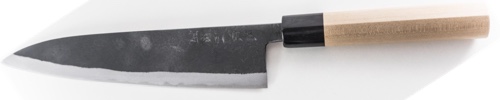
Gyuto chef knife (note handle shape and slightly straighter blade).
A chef’s knife (sometimes called a cook’s knife) is the most versatile, all-purpose blade seen in Western kitchens. It's the go-to knife for most home cooks and professionals. You can use it for almost any cutting task, from mincing garlic and chopping onions to boning chicken and carving a roast.
Chef’s knives typically have blade lengths from 6 to 12 inches, with 8 inches being the most common size. Chef's knives have a curved blade that tapers upward to a pointed tip, which makes them ideal for "rock chop" cutting, where the chef lifts the handle but the knife tip stays on the cutting board. The curved edge keeps the tip in contact with the cutting board, allowing for continuous and efficient movement.
Chef's knives are great for tasks that require speed and power, like halving melons, breaking down squash, or working through dense proteins.
Though classic chef's knives are Western knives--that is, primarily developed in German and French kitchens--there is also a Japanese version of a chef's knife called a gyuto. Gyutos tend to be made of harder steel, which makes them more brittle, and have a narrower spine and cutting angle. These features make them excellent for precision cutting, but they are not the workhorses that softer, heavier Western chef's knives are. So though the gyuto and the Western chef knife can look quite similar, they are very different knives with very different purposes.
NOTE: In this article we are comparing Western chef's knives, not gyutos, with santoku knives.
What Is a Santoku?

Classic Japanese (Miyabi) santoku (note flat blade, downward curved spine, and oval handle).
Though chef's knives are still the number one choice in Western kitchens, the santoku is rapidly gaining in popularity, largely because of its versatility. The santoku was developed in Japan after World War II as an alternative to the three traditional Japanese blades: the deba (used for fish), the gyuto (used primarily for meat and closest in design to a Western chef's knife), and the nakiri (used for vegetables). Santoku means “three virtues” in Japanese, referring to the knife’s ability to handle slicing, dicing, and chopping, and also because it can handle all three types of food, although the knife is most typically used for vegetable prep.
Santoku blades can measure 5 to 8 inches, with 7 inches being the standard length. They feature a straight (or sometimes very slightly curved) cutting edge, with a spine that curves downward to the tip (rather than a blade that curves upward to the spine, as seen in a chef's knife). This design makes santokus ideal for a straight up-and-down cutting motion, in which the entire blade is lifted off the cutting surface between cuts.
Since santokus are of Japanese origin, they tend to be made of harder steel and have a narrower cutting angle than chef's knives, although there is a wide variation today, particularly since many Western knife companies, such as Wusthof, Zwilling, Henckels, and Victorinox all make santokus out of standard German steel. They can also have a Japanese or Western handle--so the main difference between the santoku and the chef knife are the shape of the blade.
Whether you go with a Japanese brand or a Western brand of santoku will affect the design, but this is not good or bad: what matters most is whether the knife works, and feels comfortable, for the individual user.
The Differences Summarized
The table below summarizes the differences between the Western chef knife and the santoku. However, keep in mind that there can be overlaps in some of these characteristics (such as hardness, cutting angle, and handle shape). The biggest differences between the two will always be the blade shape and the cutting motion you use with each knife.
We will look at some of the differences in more detail below in our Recommendations section, which will apply only to santokus, because as far as we know, no Japanese brands make Western-style chef's knives.
Header | Western Chef's Knife | Santoku |
|---|---|---|
Origin | Western (primarily Germany and France) | Japan |
Blade Shape (main difference) | Curved edge tapers upward to tip | Straight edge with spine that tapers downward to tip |
Steel/Hardness | Softer, more durable steel w/hardness 52-58 HRC | Harder, more brittle steel w/hardness 59-65 HRC |
Cutt |