
All-in-One pans, like the Always pan by Our Place and the Caraway Sauté pan, are marketed as kitchen wonders that can replace 5 or 6 other pans. These pans look great in the ads, are lauded on social media, and are hugely popular. But how great are they, really? Do they hold up to all the promises?
We take a look at the Always pan and other all-in-one pans. What they do, what they don't do, features, pros and cons, and more to help you decide if one of these pans is right for your kitchen.
What Is an All-in-One Pan?

Our Place Always Pan, a popular all-in-one pan.
An all-in-one pan is known by a few other names, such as an Essential pan, a Chef's pan, or a multi-purpose pan. It is a pan you can use many different ways. For example, you can fry, sear, and sauté like a skillet; braise and poach like a sauté pan; stir fry like a wok; cook rice and pasta like you would in a sauce pan; make soups and stews like a Dutch oven or soup pot; even put in the oven as a roaster. "All-in-one" is a fairly new term, used primarily for marketing a pan that is traditionally known by these other names.
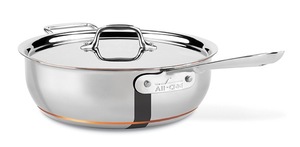
Essential pan: looks like a large sauciér.
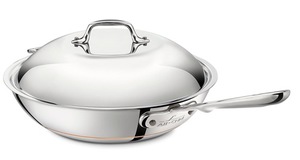
Chef's pan: looks like a deep skillet or wok.
Essential pans usually look like large sauciér pans (above left), while Chef's pans tend to look like a cross between a wok and a large, deep skillet (above right). Other multi-purpose pans include the deep sauté pan and even the Dutch oven; some people even use their carbon steel woks for soups, stews, frying, steaming, and more (note: your wok needs a lid to make it a multi-use pan). Multi-use pans always have a lid, and for the most versatility, they should be large--larger than a standard skillet or sauté pan. A good size for an all-in-one pan is 4-7 quarts (which is larger than many of the pans on the market advertised as "all-in-one" pans). Anything smaller limits the pan's versatility, as will a pan without a lid.
Though being marketed as "all-in-one" is a fairly recent thing, Chef's pans, Essential pans, deep sauté pans, and Dutch ovens have all been around for a long time. Their new competitors often come with extra pieces such as a steamer basket and a spoon or spatula and are usually on the small side, while the more traditional types are large and have a lid, but no other extras.
Can an All-in-One Pan Really Replace Several Pieces of Cookware?
All-in-one pans are designed to be versatile pieces of cookware. But practically speaking, they can't really replace several pieces of cookware.
The obvious reason for this is that when you cook a meal, you almost always need more than one pan--so even if you had a pan that you can make spaghetti sauce in and boil pasta in, you still need two pans to cook the meal, and possibly a third for a vegetable or other side. So upon closer scrutiny, the idea that you only need one pan doesn't make a lot of sense.
There are other reasons, too. Just because you can use a pan to, say, boil pasta, doesn't mean it's the best pan to use. For making pasta, it's hard to beat a deep, straight-sided sauce pan that holds at least 3 quarts (to avoid boil overs):

Sauce pans are hard to beat when a lot of liquids are involved (pasta, rice, soup, etc.).
You can use a shallower pan (like the Always Pan), but you have to be very careful with a shallow pan: You can get boil overs or, at the opposite end, have the pan boil dry, both of which are fairly common complaints with smaller all-in-one pans (i.e., less than three quarts).
(Anything smaller than three quarts is barely large enough to cook a main dish for two, much less for a family. So always be cognizant of the size of any cookware you buy.)
If you're serving just a salad with a main course like pork chops or burgers, then you can get by with one pan. But how often do you do this? And even if you do it often, any skillet or sauté pan will work; it doesn't need to be an all-in-one pan.
So while these pans can are certainly versatile, they are not the only pan you'll need in your kitchen.
Then again, the question is, "can these pans really replace several pieces of cookware?" The answer is that yes, you can use a multipurpose pan for several things; you just can't do so at the same time. And, just because you can use a pan doesn't mean it's the best pan for the job. So you will always need more than one pan--and more than one type of pan--in your kitchen.
This being the case, you should get the pans that are best at what they do: a skillet for frying; a sauce pan for liquids, rice, and pasta; a Dutch oven for stews, soups, and braises, etc.
When You Will Use an All-in-One Pan
You'll use an all-in-one pan anytime you'll use any other pan: to fry, deep fry, steam, poach, boil, bake, stew, etc. But whether or not the all-in-one pan is a good choice depends on what you're cooking.
Since most of the newer all-in-one pans are shaped like sauté pans, they're good for frying and other dry cooking tasks. They are not as good for tasks that require a lot of liquid (making rice and pasta, soups, stews, deep frying, etc.) because they can boil over easily and they are hard to move without spilling liquid.
This Isn't a New Idea
As we said, a multi-use pan is not a new idea. Chef's pans, Essential pans, deep sauté pans, and Dutch ovens have been around for decades, and all are designed for versatility.
Out of all of these, the deep sauté pan is our favorite. This is usually a 5- or 6-quart pan with high, straight sides. A clad stainless steel deep sauté pan has been our most recommended pan on this site. You can use it as a frying pan, sauté pan, sauce pan, Dutch oven, and small stock pot. It's size, shape, and material (clad stainless steel) make it extremely versatile. The best example is this 6-quart All-Clad D3 deep sauté pan:

All-Clad D3 deep sauté pan (6 qt).
The best multi-use pans are large (as we said 4-7 quarts) and deep but not too deep. The depth is an important feature because if they're too deep food won't brown well (because steam doesn't escape easily), but if they're too shallow, then cooking with liquids--deep frying or making pasta, for example--is difficult and possibly even unsafe.
The Chef's pan, Essential pan, deep sauté pan, and Dutch oven are all ideal multipurpose pans. They've been around for a long time, so pans marketed as "all-in-one" are nothing new; it's just an appealing idea that helps people think outside the box about how they can use their cookware.
Is Nonstick a Good Choice for an All-in-One Pan?
Nonstick is a terrible choice for a multi-purpose pan. Whether PTFE (Teflon) or ceramic, a nonstick coating severely limits the versatility of a pan (this is true for all pans, not just all-in-one pans). A nonstick coating means you're restricted to low heat (medium at the highest) and non-metal utensils.
Nonstick coatings are good for sticky foods like eggs and fish, but simply aren't necessary or even desirable for other foods because the nonstick coating doesn't brown as well as steel, cast iron, or carbon steel. (A nonstick coating isn't necessary for sticky foods, either, but many people keep one nonstick skillet around for them).
Another reason to avoid nonstick is that it wears out quickly, usually within a couple of years. So even if you want one, it's not a good idea to spend a lot of money on a nonstick pan. This is true for both types of nonstick, but ceramic tends to wear out faster than PTFE. Avoid buying sets because nonstick is really only needed on a frying pan (and not even there if you learn how to cook without it).
Those colorful nonstick all-in-one pans look great in ads and on social media, but they're expensive for pans that don't last, and most of them are too small to work well as a multi-use pan. Even the new 12.5-inch Always Pan, the largest size they make, is just 4 quarts, the minimum size we'd recommend for a multipurpose pan (and the original 10.5-inch pan is only 2.6 quarts, which is actually smaller than a standard 3 quart/10-inch sauté pan).
About Utensils
It's nice to get extras with a purchase, but they're not always the best option. For example, the Always Pan comes with a steamer and a spatula that fits into the handle. These both seem like they would be functional, but the design isn't great. The steamer basket is small, so it generally won't work for more than two people for a main course. The steamer handle is hard to pick up, too, and easy to burn your fingers when you're grabbing it (hint: always use a towel or pot holder to pick up the handle).
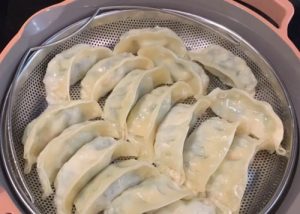
The steamer basket handles are hard to grab.
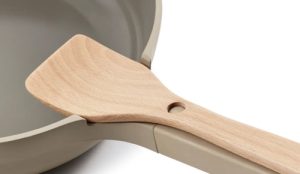
Always Pan spatula: not all that practical.
The handle on the Always Pan is designed to hold the spatula, which is clever in theory, but in practice, it isn't great. The handle is square in order to hold the spatuls, which makes it quite uncomfortable. And there's a gap in the lid the spatula fits through (see photo above right), so the lid can never fit completely air tight (the pour spouts also make an air tight fit impossible). This is kind of a big miss because you need an air tight lid to steam and braise effectively. There's no way to not lose a lot of liquid to evaporation when you don't want to.
But most of all, what happens when you've just used the spatula and it's dripping with pan goop? The goop is going to drip all over the handle and probably down onto the stove burner, causing a smelly, sticky, stuck on mess. Unless you wipe it off, which is an extra step that isn't necessary if you just use a plate or an actual spoon rest.
Whoever thought this was a good idea has probably not spent much time in a kitchen before.
So a pan that comes with extras like utensils and a steamer may seem like a good deal, but make sure these extras don't come at the expense of functional design. You're almost certainly better off using utensils purchased separately that provide better functionality: spatulas, steamer baskets, and spoon rests are inexpensive, and if you buy them separately, you can get the exact functionality you want--as well as a lid that fits the pan snugly.
Note: We don't mean to pick on the Always Pan, but it's the most popular example of an "all-in-one" pan that lacks functionality, and its extra features are a big part of the problem. Several copycats have similar issues, but there are some that provide the extras without the issues the Always Pan has.
The Essential Pieces Most Cooks Should Have
So if an all-in-one pan isn't the answer, what is? Well, if you're trying to get by with as few pans as possible, we suggest these:
Both should be oven and broiler safe and not nonstick for the most versatility. With these two pans, you will be able to do almost everything (depending on your cooking style). And large sizes are best because you can make smaller portions in a big pan, but you can't make bigger portions in a small pan.
A baking sheet is also a nice piece that's inexpensive and you can use for a ton of different things. For the best deals, find a restaurant supply store, which usually has them for under $10.
You will also need utensils like a knife, turner, spoon, spatula, whisk, strainer, cutting board, etc., but that is another topic: non-cookware essentials that every kitchen needs. There are a million online articles and YouTube videos on this topic, some that recommend just a few pieces and some that recommend dozens for a "well stocked" kitchen. But before you take anyone's advice about what's "essential" for your kitchen, make sure it's something you'll actually use. Your list may be very different than somebody else's; it's a topic we haven't tackled yet for this very reason.
We do, however, have an article on cookware essentials you may find helpful: 5 Essential Cookware Pieces (and Sizes).
Pros and Cons of a Multipurpose Pan
If you don't expect that your multi-use pan will be a substitute for all of the other pans in your kitchen, then there aren't really any cons. You can use the pan for what it's best at.
The truth is, there's no such thing as a pan that does it all, so there are certainly pros and cons to consider before you invest in a multi-use pan. Here are the most important ones we can think of: