
A wood cutting board is a simple but essential kitchen tool. And even though it's a simple block of wood, there are a lot of factors to consider before buying. Not all wooden cutting boards are created equally, so if you want to get the most durable quality and one that's best for your knives and your cooking style, you have to know what to look for.
We put a dozen popular wood cutting boards through their paces to find our favorites. We cut meat, veggies, fruit, and herbs for several weeks to test performance. Find out which ones came out on top (and why) in this detailed look at wood cutting boards.
The Best Wood Cutting Boards at a Glance
Wood Cutting Board | Features |
|---|---|
 | -Sustainably produced end grain maple -18" x 12" x 2" -12.5 lbs -Soaked in food-grade mineral oil -Buffed with food-grade beeswax -Recessed handles -Optional rubber feet -Made in USA -About $215. |
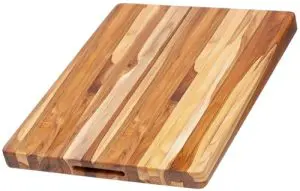 | -FSC certified edge grain teak wood, sustainably produced -20" x 15" x 1.5" (several sizes available) -10.5 lbs -Recessed handles -No juice groove (avail. on some sizes) -No feet -About $95. |
 | -Edge grain maple -17" x 13" x 1.5" -8 lbs -Made in USA -Recessed handles -Deep juice groove -Cracker well on one side -No feet -About $65. |
Best Splurge Cutting Board: Brooklyn Butcher Block End Grain Cutting Board 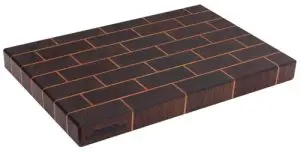 | -Black walnut and cherry wood -18"x12"x1.75" -12 lbs -Made in USA -No handles or feet (all cutting surface) -Beautiful brick pattern -About $350. |
What Are Wood Cutting Boards Used For?
Wood cutting boards are great for most cutting tasks. They are better for the edge retention on your knives than plastic or bamboo (and of course better than glass or marble), they are naturally anti-bacterial, and they are a pleasure to cut on (though the type of wood matters, which we talk about more below).
Most chefs and serious home cooks prefer wood cutting boards for their main prepping board because wood is an excellent surface for cutting vegetables, herbs, and fruits. They are also excellent for meat carving boards, especially if they have a groove to catch the meat juices, and some also have a well, extra grooves, or even spikes to catch juices and keep meat stable while cutting:

Maple meat carving board with grooves, a well, and spikes to keep the meat stable.
One task wood cutting aren't the best for is cutting raw meat. This is only because you have to wash wood boards by hand (they are not dishwasher safe), so there can be a higher risk of cross-contamination than with a plastic board, which you can toss in the dishwasher.
You can use a wooden cutting board for raw meat, you just have to be sure to wash thoroughly.
The Janka Hardness Rating
The Janka Hardness Scale determines the resistance of wood to denting and wear. It is measured in pounds-force or lbf. It was created by Austrian wood scientist Gabriel Janka in 1906.
The number of pounds-force indicates how much force is needed to drive a steel ball halfway through a sample of the wood. The more force (lbf), the harder the wood is, meaning the resistant to denting and wear.
The Janka scale is used primarily for woods that are used for flooring, countertops, and cutting boards. For cutting boards, the hardest wood isn't necessarily the best. Harder wood is harder on your knives.
For cutting boards, most experts agree that the ideal Janka rating is between 900-1500 lbf. Here's a table showing the Janka ratings of popular cutting board woods:
Wood | Janka Hardness Rating (lbf) |
|---|---|
Ideal Janka rating for cutting boards is between 900-1500 lbf. | |
Hard Maple | 1,450 |
Black Walnut | 1,010 |