
Lamson is an American kitchen knife brand that's been around since 1837. Some of their knives are beautiful--but are they any good?
We take a detailed look at the Lamson knife lines and discuss features, buying options, pros and cons, and more to help you decide.
Lamson Knives at a Glance
Lamson makes just two lines of knives, the Premier Forged and the Vintage/Brad Leone Signature Series, which are identical except for Brad Leone's signature etched onto the Brad Leone blades. Thus, if you're interested in one of these knives, we recommend going with the one that you find at the lowest price, which is usually the Vintage series.
All Lamson products come with a lifetime warranty against manufacturing defects.
Lamson Knife | Features |
|---|---|
 | -4116 steel (high carbon German steel) -Forged -20 degree double bevel cutting angle, flat grind -Full tang, full bolster -Hardness rating 58 HRC -Handles: acrylic, G-10, striated wood, walnut -Triple riveted -5 handle colors: fire, ice, midnight, sierra, walnut -Made in USA -8" chef's knife about 8oz. -8" chef's knife about $160. |
 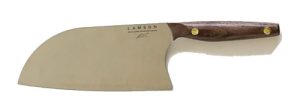 | -Identical except for Brad Leone's signature on blade of Brad Leone Series -420HC-LAM steel (high carbon American steel) -Stamped -20 degree double bevel cutting angle, flat grind -Full tang, "integrated" bolster (part of handle) -Hardness rating 58 HRC -Walnut handles w/2- or 3-rivet construction -Made in USA -8" Chinese santoku 12oz. -8" Chinese santoku about $100 (Vintage) or $110 (Brad Leone). |
Other Lamson Products
We are looking at knives in this review, but Lamson makes several other kitchen products, which we listed and linked here. Links go to the Lamson website.
Knife storage (sheaths, rolls, blade guards, and blocks)
Knife sharpening tools (steels, stones, handheld sharpener, and more)
Kitchen utensils (all non-knife utensils, including Vintage and Tree Spirit lines)
Bbq utensils (tongs, turners, forks, etc., including sets)
Silicone accessories (hot pads, handle covers, coasters, bowls, funnels)
About Lamson
Lamson is an American company founded in 1837, making it one of the USA's oldest cutlery companies. Today their products are still made in the USA, although their forged blades are imported from Germany.
Lamson filed for bankruptcy in 2014, but was purchased by private investors and reorganized at a new manufacturing site in Westfield, Massachusetts. The company has about 35 employees and has sales of about $3 million yearly.
Using Lamson Knives (How We Tested)
We tested the Premier Forged chef's knife, the Vintage Chef's knife, and the Vintage/Brad Leone Chinese cleaver. The first thing we did was measure out-of-box sharpness with a professional edge tester.
The lower the number, the sharper the knife. For reference, we're looking for a sharpness below 400 grams, per this table of sharpness standards:

We tested each one three times and to make sure we got accurate readings. Here are the results:
Lamson Premier Forged chef's knife: 170g
Lamson Vintage chef's knife: 130g (razor sharp)
Lamson Vintage Chinese Cleaver: 133g
Maybe we could have assumed that the Vintage chef's knife and cleaver would have the same edge, but because they're so different, and because the Chinese cleaver is one of Lamson's most popular and best-selling knives, we tested them both.
After sharpness testing, we put the knives to work in the kitchen as you would use any chef's knife (or santoku cleaver), cutting many foods for about a month, including onions, garlic, carrots, potatoes, tomatoes, apples and other fruits, plus cheeses, meats (cooked and raw), squashes, and more.
We also cut up whole chickens to test how the blades worked with bones, and cut partially frozen beef into thin (carpaccio-style) slices. You can find our results below in the more detailed reviews for each knife.
Who Are Lamson Knives For?
Lamson knives are pretty good all-purpose kitchen blades. They are not the world's highest quality knives, but they are far from low quality. They are roughly equivalent to Wusthof knives as far as quality, cutting edge, and handle.
If you like a heavy, German-style forged knife, then the Premier Forged line is for you; if you prefer lighter knives, then go with the Vintage/Brad Leone line.
Steel Used in Lamson Knives
Lamson uses two kinds of steel:
4116 steel: Also called X50CrMoV15, this is standard issue high carbon German steel. In fact, Lamson imports these blades pre-made from Germany for their Premier Forged line. This is good quality steel, very corrosion resistant, with a hardness of 58 HRC, which means it will hold an edge fairly well yet be soft enough so that it's easy to sharpen. This steel is seen in many, if not most, German knife brands, including Wusthof.
420HC-LAM steel: This is a high carbon American stainless steel. Like the 4116 steel, it is considered a mid-range quality steel that's very corrosion resistant and fairly soft, so it doesn't hold an edge very long but is easy to sharpen. Lamson uses this steel on their stamped Vintage/Brad Leone line of knives.
Also, though we aren't reviewing Lamson's line of kitchen utensils, they use a 301 stainless steel for those (presumably because they don't need to hold a sharp edge).
Handle Material of Lamson Knives
Lamson uses a few different handle materials on their knives. Here they are in alphabetical order:
G10: G10 is made up of layers of fiberglass cloth soaked in phenolic resin, then compressed at high heat. G10 is extremely hard and strong, yet still lightweight. G-10 comes in many colors and has a firm, comfortable grip with a somewhat rough surface texture.
G10 is the toughest fiberglass resin laminate known and is also water and heat resistant. It is an excellent synthetic handle material.
G10 is used on the Premier Forged Midnight series.
Pakkawood (aka Striated Wood): Pakkawood is a combination of layered wood and resin (plastic) that makes for a durable and hygienic handle. It is most often seen on Japanese knives but because of its durability is becoming more popular with Western knife makers.
Pakkawood is used on the Premier Forged Sierra line.
POM: POM stands for polyoxymethylene, a thermoplastic material (i.e., acrylic) with extreme durability and resistance to damage from heat and cold. POM is naturally resistant to bacteria, making it a hygienic choice; it is an choice option for most cooks.
POM is used on the Premier Forged Fire and Ice series.
Walnut: Walnut is a dense, tight-grained, durable wood. Lamson infuses their walnut handles with resin, which seals the wood to protect it from moisture and improve durability. (On some of their other kitchen utensils, the walnut is left natural).
Infused walnut is used on the Premier Forged Walnut series and on the Vintage/Brad Leone series.
Interesting Features of Lamson Knives
Here are some interesting facts about Lamson knives.
Oldest Cutlery Company in the United States
Founded in 1837, Lamson is the oldest cutlery company in the United States. They have been making knives and other kitchen and barbecue tools since 1837 and are close to entering their third century of business.
Made a Dinner Set for a US President
In 1869, Lamson presented new U.S. President Ulysses S. Grant with a fine 62-piece dinner set. They had ivory and mother of pearl handles, and were so extraordinary that today, some pieces from the set are displayed at the Smithsonian Institution in Washington, DC.
Used By Culinary Schools
Lamson knives are used in many culinary schools in the USA.
Still Have a 20 Degree Double Bevel (Cutting Angle)
Most German style knives have switched to a 15 degree double bevel cutting angle, but Lamson is still old school and has a 20 degree double bevel. These have fallen out of favor because a 15 degree angle feels much sharper (even if it isn't all that much sharper). But there are advantages to a 20 degree double bevel, too, such as being more durable and less prone to chipping.
If you don't like the 20 degree bevel, you can sharpen it (or have it sharpened) to a 15 degree angle. This is easy to do with a sharpener like the Chef'sChoice Trizor XV, or any pull-through sharpener with a 15 degree angle, or on a whetstone with 15 degree angle guides.
Lamson Premier Forged Vs. Wusthof Classic
Lamson Premier Forged chef's knife.

Wusthof Classic chef's knife.
Both Lamson Premier Forged and Wusthof are top quality German knives. Here, we compare the chef's knives of the flagship lines of each brand, which are the Lamson Premier Forged and the Wusthof Classic.
See our Wusthof review for more information.
Steel: Both are forged. Lamson uses 4116 high carbon German steel and Wusthof uses X50CrMoV15 steel. Though they call them different things, these steels are identical (or nearly identical) in composition.
Sharpness: Both have a hardness rating of 57-58 HRC.
Edge Retention: Because the steel and hardness rating are identical, edge retention will be about the same.
Cutting Angle: