
Oven-safe skillets are a great advantage in the kitchen. They can save you time and make your life easier by having to only wash one pan instead of two (or more).
Oven-safe skillets aren't hard to find, but you do have to make sure your skillet is safe and durable enough to stand up to oven heat. We look at all the heating, durability, and safety issues involved in finding the best oven-safe skillets.
Our Favorite Oven Safe Skillets at a Glance
Here is a list of basic oven safe cookware materials. The oven safe temp can vary--and barring plastic or silicone handles and glass lids--you should be safe to 500F.
NOTE: Most skillets do not come with a lid. If they do, the lid may have a different oven-safe temp than the pan itself. If your skillet has a lid and you don't know its temperature limits, be careful using it in the oven, especially if it contains glass and/or silicone or plastic parts.
Pan Type/Example | Pros | Cons |
|---|---|---|
Clad Stainless Steel All-Clad D3 tri-ply skillet w/lid  | -Lightweight -Typically oven safe to 500F -Typically broiler safe -Safe and non-toxic -Durable -12" about $130. | -Cheaper brands may have lower oven safe temps -Cheaper brands can warp under high heat -Glass lids typically oven safe to 350F -Good brands can be expensive. |
 | -Safe to any temp -Great for high heat searing -Typically broiler safe -Safe and non-toxic -Durable -Affordable: 10" about $20. | -Heavy -Usually no lid included -Must be seasoned or can rust. |
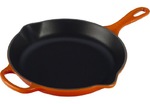 | -Oven safe to at least 500F -No seasoning required -Typically broiler safe -Safe and non-toxic -Durable -Enamel is semi-nonstick -11" about $240. | -Top brands are expensive -Heavy. |
 | -Most brands oven safe to at least 500F -Great for high heat searing -Lighter than cast iron -Typically broiler safe -Safe and non-toxic -Durable -Affordable: 10" about $55. | -Can be heavy -Must be seasoned or can rust. |
 | -Oven safe to at least 500F w/stainless lining -Durable -Safe and non-toxic -Typically broiler safe -10" about $350. | -Expensive -Tin-lined will melt at about 400F -Thick copper cookware can be heavy -Do not confuse fake copper with real copper (it's not oven safe). |
Do I Really Need an Oven Safe Skillet?
Whether or not you need an oven-safe skillet depends on how you cook.
Do you like to sear steaks on the stove top and finish by roasting them in the oven? Or brown chicken thighs, roasts, and pork chops and finish them in the oven (perhaps with a delicious sauce)?
Do you make frittatas, which you set on the stove top, then bake to perfection?
Do you like to do oven braises of tough cuts like chuck? If so, they can benefit greatly from a stove top sear before braising in a covered pan.
Or maybe you love cornbread, which gets a delicious crust from baking in a cast iron skillet.
There are times to use a roasting pan: whole chickens, rib roasts, and pork loins, for example. But there are many occasions when an oven-safe skillet comes in really handy.
Oven Safe Materials
Unless you're a nonstick person, chances are you already own at least one oven-safe skillet. The truth is, most skillets are oven safe to some degree, although that temperature changes by material and pan construction.
Here are all the cookware materials that are oven safe--but be sure to read the next section, as well, which covers other important considerations. Not all "oven safe" materials are actually oven safe, or at least not oven safe to a high temperature.
Clad Stainless Steel

Our favorite oven-safe skillet material is clad stainless steel. Steel pans are durable, safe, and most have even heat distribution. Best of all, good quality steel skillets are oven safe up to 500F, as long as they are 100% steel (e.g., no plastic or silicone parts). This includes All-Clad, Demeyere, Tramontina Tri-Ply Clad, Heritage Steel (safe to 800F!), 360 Cookware, Made In, Misen, Sardel, Viking, and more.
Some lower quality clad stainless steel pans are oven safe to lower temperatures. We're not sure why, since most stainless is at least 18/8 grade, but some brands aren't as oven safe as others. If you don't have one of the brands listed above, or aren't sure, you should probably limit the oven temp to no more than 400F.
Cast Iron

Cast iron is another great choice for the oven, as long as it is 100% cast iron with no plastic or silicone parts.
Most cast iron is oven safe to temps that home ovens can't achieve, so there are few worries about using your cast iron at high heat.
Even if you don't have instructions for your cast iron, you can be confident that it will be oven safe to at least 500F.
Cast iron does have a few drawbacks, though. First, it's heavy, so when it's full of food, it can be a handful to get in and out of an oven.
Second, high heat and liquids can be hard on the seasoning, so if you're using your cast iron in the oven frequently, or with liquids (like cornbread batter), you may find that it needs to be re-seasoned more often than if you're using it primarily for stove-top searing.
Carbon Steel
Like cast iron, carbon steel is also oven safe to very high temperatures, so you should have no worries using it in the oven if it is 100% carbon steel (no plastic or silicone parts). According to this article, most carbon steel pans are oven safe to 600F, and some are safe as high as 1200F.
The only exception to this that we're aware of is Viking carbon steel, which has an oven safe temp of just 450F, probably because of the stainless steel handles.
Carbon steel isn't as heavy as cast iron, but it's still heavy, so be aware of that. Traditional French carbon steel pans are also fairly shallow, so they're not a great choice for liquids (in the oven or otherwise).
And the same seasoning issues that apply to cast iron also apply to carbon steel.
But for oven roasting proteins and veggies, carbon steel is an excellent choice.
Enameled Cast Iron

Enamel on cast iron (or carbon steel, which is becoming more popular) is typically made from ground up glass that's melted and sprayed onto cookware. It is extremely durable and heat resistant, making enameled cast iron (or carbon steel) an excellent choice for oven use.
Most enameled cast iron/carbon steel is oven safe to at least 500F. Sometimes the pans have lid pulls that may not be quite as heat resistant, but the cookware itself should be fine to 500F as long as it has no plastic or silicone parts.
This article is about skillets, but our recommendation for enameled cast iron is a Dutch oven. Cast iron Dutch ovens are more versatile than skillets and are the ideal pot for oven braising. You can use them for everything from searing proteins to baking artisan bread--and no seasoning needed.
An enameled cast iron skillet is also a nice piece, but if you want a pan for braising (which requires a tight-fitting lid), the Dutch oven is the way to go, especially if you already own a clad stainless skillet.
Aluminum and Anodized Aluminum

Aluminum is oven safe as long as it doesn't have plastic or silicone parts or a nonstick coating on the cooking surface (more on this below).
In fact, some of the highest quality bakeware is aluminum, so even if you haven't thought to put an aluminum skillet in the oven, you probably already own some aluminum pans designed for oven use.
Anodized aluminum is an even better choice because it's tougher and also non-reactive, so there are no worries about your food taking on a metallic taste from the pan.
The biggest problem with most aluminum cookware is that it has a nonstick coating, and many brands also have plastic handles, both of which make them a no-go for oven use.
However, there are some brands on the market that don't have a nonstick coating or plastic parts, making them very safe for oven use. Lloyd's is a brand that makes anodized aluminum cookware with no PTFE coatings or plastic parts and are excellent for oven use--safe up to 700F.
Copper

See how long the handle is?
Most real copper (not the fake copper-colored nonstick) is oven safe to at least 450F and some is safe up to 600F.
If the copper pan has tin lining, do not use about 400F, as tin begins to melt around 450F.
If the copper pan has stainless steel lining, then it is probably oven safe to at least 500F.
Copper is kind of the ultimate all-purpose cookware, but it's expensive and heavy and needs polishing a few times a year to keep its lustrous shine, so it's not as popular among home cooks as clad stainless and cast iron. But if you want copper cookware, it's an excellent choice for both stove top and oven use.
Probably the biggest drawback of copper skillets is that the traditional French design has a very long handle, so a skillet may not in a smaller oven.
Glass and Stoneware

Nearly all glass and stoneware is oven safe, as long as it is 100% real glass or stoneware and not "granite" or "stone" nonstick coating (more on this below).
We aren't big fans of glass and stoneware for the stove top for a few reasons: it heats extremely slowly and unevenly, it's fragile, and it's heavy. People who buy it are generally trying to avoid toxins in their cookware, but you can do that with good quality clad stainless, cast iron, and all the other choices we've listed here, and still get good heating properties and durability that you won't get from glass and stoneware.
However, bakeware is a different story, and glass and stone bakeware is an excellent choice. The insulating properties help batters bake evenly without getting too much browning on the edges before the inside is done. And you can use them for proteins, veggies, and other foods with similar great results.
The only problem is that most glass and stone bakeware is not safe on the stove top: it can crack if placed on direct heat.
So while some people do use glass and stone skillets, we don't recommend them. But for oven pans--cakes, lasagna, roast chickens, etc.--glass and stone bakeware is a great choice.
Important Considerations
Here are some other helpful considerations if you're trying to decide if your skillet is oven-safe, or if you want to use it in the oven.
Instructions
Most cookware comes with operating instructions, and these will list the oven safe temperature for the cookware and the lids (if different).
If you didn't keep the paperwork for your cookware handy (and who does?), then here's what to think about before putting it in your oven.
Look Up the Cookware Brand
If you know the make and model of your cookware, you can just look for it on the Internet. Most makers list oven safe temps for their cookware, or you can often find it on the Amazon listing, too.
Just be sure you're looking up the exact line of cookware you own, because many makers have several lines, and they can have different oven-safe temps.
Look for Markings
Some cookware is marked for it's safe use. There are icons for oven, microwave oven, freezer, dishwasher, and more. Here's one symbol for "oven-safe:"

Unfortunately, there is no universal standard so icons can vary greatly, though an "oven-safe" will usually look something like this one (not always accompanied by words).
But just as unfortunately, we weren't able to find icons on any of the cookware we looked at. This doesn't mean yours won't have it, but it may not.
If your pan doesn't have an oven safe logo and you're not sure if it's oven safe, look at the following features to help you decide.
Handles (No Plastic!)
If your pan has non-metal handles or lids, then you should think twice about using it in the oven and especially under the broiler.
It may still be oven safe, but it's hard to say. Many plastics and resins may withstand oven temps, but oven heat can take a toll on them, causing them to break down sooner than they otherwise would. So even if you have a skillet with plastic or silicone handles that's labelled "oven-safe," we recommend not using it in an oven.
And never under a broiler.
If your pan is all one material--metal body, metal cooking surface, metal handle and lid--then it's probably oven safe. If you don't know what the oven safe temp is, though, you should avoid temps above 350F.
Short Handles (Or Removable Handles)
Some skillets are made with two short handles specifically to make them easier to use in an oven, like this Lodge short-handled skillet: